
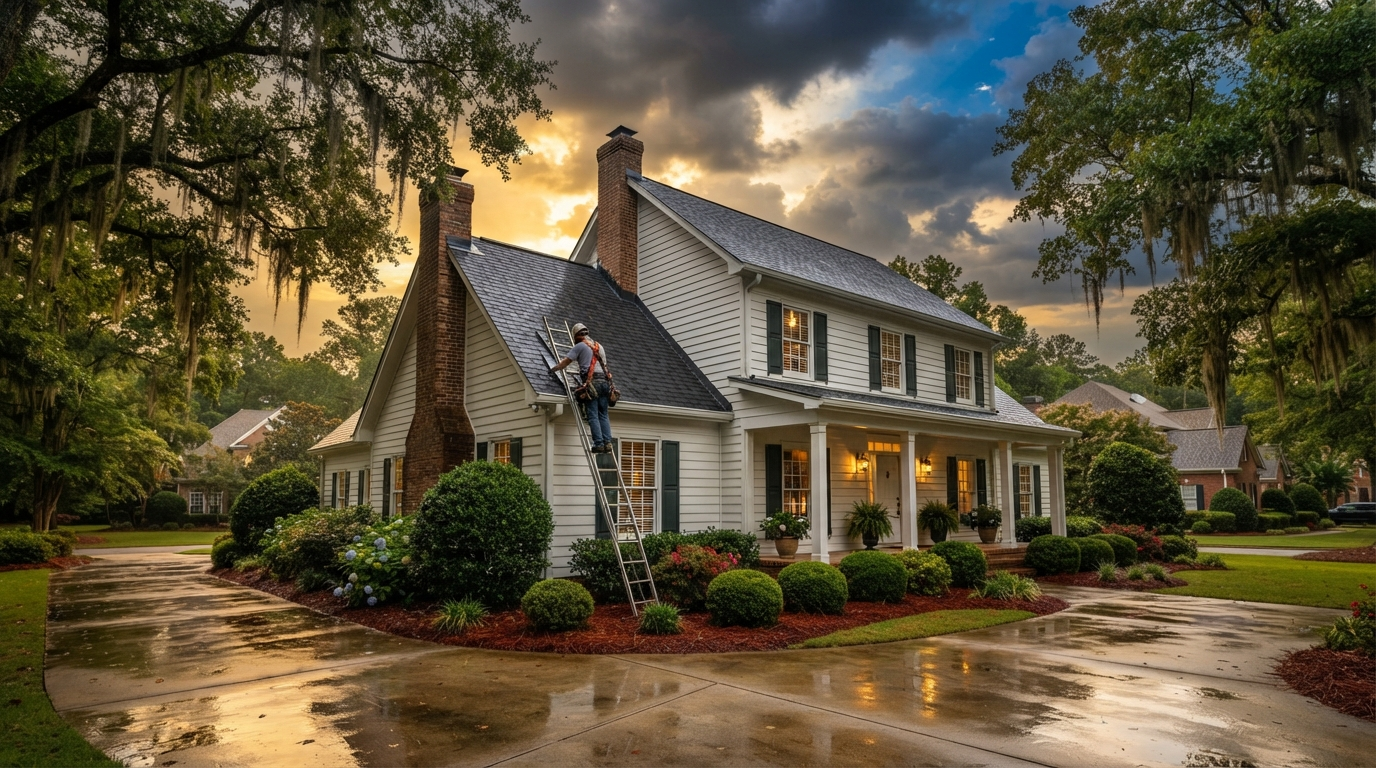
When a storm rolls through Norcross and you notice bare patches on your roof alongside rust-stained metal around your chimney, you are dealing with a common but serious combination of damage. Shingle roof repair in Norcross GA for missing shingles and flashing issues demands prompt attention because these two problems rarely occur in isolation. The same wind that tears shingles from your roof also lifts and damages the metal flashing that protects vulnerable intersections. At GCR Construction & Roofing, we have spent 15 years helping Gwinnett County homeowners understand why addressing both issues together saves money and prevents recurring leaks. This guide walks you through everything you need to know about identifying, repairing, and preventing this dual damage scenario that plagues homes across our service area.
Your roof functions as an integrated system where every component depends on the others for proper protection. When missing shingles expose the underlayment and damaged flashing allows water to seep behind walls, the clock starts ticking on secondary damage that can cost thousands to repair.
Within 24 hours of losing shingles, exposed underlayment begins absorbing moisture during rain events. This synthetic or felt material provides temporary protection, but it was never designed for direct weather exposure. Most underlayment fails within two to three weeks of continuous exposure, at which point water reaches your roof decking.
Damaged flashing creates an even faster pathway for water intrusion. Unlike missing shingles that expose a relatively flat surface, compromised flashing allows water to channel directly into the most vulnerable areas of your roof structure. Chimney flashing failures can send water cascading down interior walls within hours of a heavy rain.
Once water penetrates your roof system, it rarely stays in one place. The damage progression typically follows this pattern:
Homeowners in Lawrenceville, Snellville, and throughout Gwinnett County often tell us they noticed ceiling stains months after a storm, not realizing the damage started much earlier. By the time water becomes visible inside your home, significant hidden damage has usually occurred.
The Norcross climate creates particularly challenging conditions for damaged roofs. Our area receives approximately 52 inches of rain annually, spread across frequent afternoon thunderstorms from spring through fall. High humidity levels, often exceeding 70 percent, prevent moisture from evaporating quickly once it enters your roof system.
Summer temperatures that regularly climb into the 90s accelerate the growth of mold and mildew in damp roof structures. Winter brings occasional ice that can further damage already compromised flashing. This combination of heavy rainfall, high humidity, and temperature extremes means roof damage in Norcross progresses faster than in drier climates.
DIY vs. Professional Shingle & Flashing Repair
DIY Repair
Professional Repair (Recommended)
Sources: NRCA Industry Statistics 2024, OSHA Safety Data, HomeAdvisor Cost Guide — Georgia Region
You do not need to climb onto your roof to spot signs of damage. In fact, we strongly recommend against homeowner roof inspections due to safety risks. Ground-level observation and attic inspection reveal most problems without putting yourself in danger.
Walk around your home and look at your roof from different angles. Missing shingles create obvious color variations where darker underlayment or exposed decking contrasts with surrounding materials. Pay special attention to roof edges, ridges, and areas around penetrations where wind damage concentrates.
Use binoculars for a closer look without leaving the ground. Look for:
Check your gutters and the ground around downspout outlets after heavy rain. Asphalt shingles shed granules throughout their lifespan, but excessive accumulation signals accelerated wear. New roofs lose some granules during the first year, but established roofs should show only minimal granule loss.
Granules that resemble coarse black sand in significant quantities indicate your shingles have lost their protective coating. These weakened shingles become more susceptible to wind damage and are often the first to blow off during storms. Homes in Sugar Hill, Suwanee, and other Gwinnett communities regularly experience this issue on roofs over 15 years old.
Roof flashing repair in Norcross frequently involves chimneys, plumbing vents, skylights, and wall intersections where metal components seal gaps. From ground level, look for these warning signs:
Step flashing along sidewalls and counter flashing on chimneys fail frequently in our climate due to thermal expansion cycles and storm damage. These failures often go unnoticed until interior leaks develop, making regular visual inspection essential.
Understanding why missing shingle replacement in Georgia remains so common helps you protect your investment and recognize when professional attention becomes necessary. Several factors specific to our region contribute to these problems.
Severe thunderstorms in Georgia often produce straight-line winds exceeding 60 miles per hour, well above the threshold where shingle damage becomes likely. These winds do not strike your roof uniformly. Instead, they create areas of negative pressure that literally suck shingles upward from the surface.
Roof edges and corners experience the highest wind uplift forces. Building codes require enhanced fastening in these areas, but many older homes in Dacula, Buford, and Braselton were built before current standards took effect. Even properly fastened shingles can fail when seal strips degrade, allowing wind to catch lifted edges and peel shingles back.
The same wind forces that remove shingles also stress flashing installations. Counter flashing embedded in chimney mortar can work loose when the entire roof structure flexes under wind load. Drip edge flashing along eaves takes particular abuse during storms with horizontal rain.
Asphalt shingles rely on a heat-activated adhesive strip to bond each course to the one below it. This seal strip creates a unified surface that resists wind uplift. However, this adhesive has a limited lifespan.
After 12 to 15 years in the Georgia climate, seal strips begin losing their grip. Ultraviolet radiation breaks down the adhesive compounds, while repeated heating and cooling cycles stress the bond. Once seal strips fail, shingles become vulnerable to winds as low as 40 miles per hour, speeds that occur during ordinary summer storms.
We see this issue frequently during inspections in Duluth, Peachtree Corners, and Lilburn, where many neighborhoods feature homes built in the early 2000s now reaching the age where seal strip failure becomes common.
Many roof leak repair Norcross GA calls we receive trace back to installation shortcuts taken years or even decades earlier. Proper flashing installation requires time and skill that some contractors skip to save labor costs. Common installation errors include:
These installation defects often remain hidden until storms test the roof system. A roof can look perfectly adequate for years while harboring flashing problems that only become apparent during heavy rain driven by strong winds.
Professional shingle roof repair in Norcross GA for missing shingles and flashing involves more than simply nailing down new materials. Quality repairs address root causes and integrate new components with existing materials for long-lasting results.
Shingle manufacturers produce hundreds of color variations across dozens of product lines. Over time, sun exposure fades colors and manufacturers discontinue specific shades. Achieving an acceptable color match requires experience and often samples from multiple sources.
Our process for matching shingles includes:
Dimensional shingles present additional matching challenges because their layered design creates shadows that vary by viewing angle. A color that appears perfect from one direction may look obviously different from another. Professional roofers understand these nuances and adjust placement accordingly.
Damaged flashing repair cost varies significantly based on the type and location of flashing involved. However, the repair process follows consistent principles regardless of specific application.
For chimney flashing, proper repair typically requires:
Pipe boot flashing around plumbing vents represents one of the most common failure points. The rubber collar that seals around the pipe deteriorates in Georgia heat and eventually cracks. Replacement involves removing several shingles, installing a new boot, and properly layering shingles above and below the flashing.
Sealants play a critical role in roof repairs but require correct selection and application. Many homeowners have experienced temporary repairs using inappropriate caulk that fails within months. Professional repairs use specific products for each application:
Proper sealant application requires clean, dry surfaces and appropriate temperatures. Applying sealant over dirt, moisture, or during cold weather leads to premature failure. This attention to conditions explains why quality repairs sometimes require scheduling around weather windows.
Understanding typical costs helps you evaluate estimates and budget appropriately for necessary repairs. Prices in the Gwinnett County market reflect local labor rates, material availability, and the specific challenges of working in our climate.
The following table provides realistic cost ranges for common repairs in the Norcross area:
| Repair Type | Price Range | Factors Affecting Cost |
|---|---|---|
| Minor shingle replacement (1-10 shingles) | $150 – $350 | Roof pitch, accessibility, matching difficulty |
| Moderate shingle repair (10-25 shingles) | $350 – $700 | Extent of deck damage, number of affected areas |
| Pipe boot flashing replacement | $150 – $300 | Roof pitch, boot size, surrounding shingle condition |
| Step flashing repair (per 10 linear feet) | $200 – $400 | Siding type, original installation quality |
| Chimney flashing complete replacement | $500 – $1,500 | Chimney size, mortar condition, counter flashing type |
| Valley flashing repair (per 10 linear feet) | $300 – $600 | Valley type, shingle removal required |
| Combined shingle and flashing repair | $400 – $1,200 | Scope of damage, number of penetrations affected |
These ranges reflect complete, professional repairs including materials, labor, and cleanup. Significantly lower quotes may indicate shortcuts such as using sealant instead of proper flashing replacement or failing to address underlying damage.
Several variables cause repair costs to fall above or below typical ranges:
Roof pitch significantly impacts labor time and safety requirements. Steep roofs require additional equipment and slower work pace, increasing labor costs by 20 to 40 percent. Most homes in Grayson, Loganville, and Auburn feature moderate pitches, but some architectural styles include steep sections that affect pricing.
Accessibility challenges such as tall homes, limited ground access for equipment, or obstacles like pools and landscaping can increase costs. Conversely, single-story homes with clear access around the perimeter typically fall at the lower end of price ranges.
Material availability affects timing and sometimes cost. Discontinued shingle colors may require special ordering or substitution. Unusual flashing configurations around custom architectural features require fabrication rather than standard parts.
The condition of surrounding materials influences repair scope. When we find deteriorated decking beneath missing shingles or rotted fascia behind failed drip edge, the repair must address these issues to provide lasting results.
Most shingle and flashing repairs can be completed within a single day once materials are on hand and weather cooperates. The overall timeline from initial call to completed repair typically follows this pattern:
Emergency situations such as active leaks during rain events may warrant temporary protection measures that can be deployed immediately, with permanent repairs following when conditions allow proper installation.
Not every damaged roof warrants repair. Sometimes the most honest recommendation is partial or complete replacement. Understanding the factors that influence this decision helps you evaluate recommendations you receive.
Asphalt shingle roofs in Georgia typically last 15 to 25 years depending on quality, color, and maintenance. Repairs on roofs younger than 12-15 years almost always make economic sense assuming damage is localized. Repairs on roofs older than 20 years require careful cost-benefit analysis.
Consider this guideline: if repair costs exceed 30 percent of replacement cost and the roof has passed 75 percent of its expected lifespan, replacement often provides better value. You get new materials with full warranty protection rather than patched old materials approaching failure.
Metal roofing, one of our roofing services, offers significantly longer lifespans of 40-70 years. Repairs to metal roofs remain cost-effective much longer because the underlying materials have substantial remaining life.
Localized damage affecting less than 10-15 percent of roof area typically warrants repair. Widespread damage crosses the threshold where repair costs approach replacement costs while leaving you with an aging roof everywhere repairs were not performed.
Specific conditions that often indicate replacement rather than repair include:
During our free inspections, we document all conditions and explain our reasoning when recommending repair versus replacement. We believe homeowners deserve honest assessment, not sales pressure toward unnecessary work.
Storm damage from wind, hail, or falling debris often qualifies for homeowners insurance coverage. Understanding how insurance affects your repair-versus-replacement decision can significantly impact your out-of-pocket costs.
Insurance adjusters assess whether damage is repairable or requires replacement based on industry guidelines. If storm damage affects one slope of your roof, the insurance company may approve full roof replacement to ensure color matching. However, this varies by policy and adjuster interpretation.
Key points for insurance claims:
Many homeowners in Berkeley Lake, Mulberry, and Rest Haven have navigated insurance claims with our guidance. We help document damage thoroughly and can meet with adjusters to ensure accurate assessments.
Repair costs for missing shingles and flashing in Norcross typically range from $150 for minor shingle-only repairs to $1,500 or more for extensive combined damage. Most homeowners pay between $400 and $800 for repairs involving both missing shingles and flashing issues at one location such as a chimney or wall intersection. Factors that influence cost include roof pitch and accessibility, the number and location of affected areas, whether decking damage exists beneath the missing shingles, and the type of flashing that needs replacement. Chimney flashing repairs tend toward the higher end because they require proper counter flashing installation into mortar joints. Simple pipe boot replacements with a few surrounding shingles fall toward the lower end. We provide detailed written estimates after our free inspection so you understand exactly what repairs involve and why costs are what they are.
While replacing a few shingles appears straightforward, we recommend professional installation for several important reasons. First, roof work presents serious safety hazards including falls, especially on pitched roofs common in our area. Second, proper shingle installation requires understanding correct nail placement, proper overlap, and seal strip activation that affects long-term performance. Many DIY repairs fail within a few years because of installation errors invisible at completion. Third, identifying all damage requires trained eyes. Missing shingles often indicate broader problems such as seal strip failure across the roof or damaged flashing that homeowners may not notice. Finally, professional repairs maintain warranty protection and provide documentation valuable for insurance claims and home sales. If you are determined to attempt DIY repair, limit yourself to easily accessible low-slope areas, never work alone, and use proper fall protection equipment.
You should address missing shingles as soon as possible, ideally within one to two weeks of discovering the damage. The underlayment beneath shingles provides temporary protection, but it degrades quickly when exposed to direct sunlight and weather. In Georgia’s climate with frequent rain and high humidity, exposed underlayment can fail within two to three weeks. Once water reaches the roof decking, damage accelerates dramatically. We have seen cases where a few weeks of delay resulted in thousands of dollars in additional repairs including decking replacement, insulation removal, and mold remediation. If you cannot schedule permanent repairs immediately, temporary measures such as tarping can protect your home during the interim. Contact us promptly after storms or upon discovering damage so we can inspect and at minimum recommend protective measures until repairs can be completed.
Homeowners insurance typically covers missing shingles and flashing damage caused by covered perils such as wind, hail, and falling objects like tree branches. However, insurance does not cover damage from normal wear and aging, lack of maintenance, or gradual deterioration. The key question is whether a specific event caused the damage. If a windstorm removed your shingles, that claim should be covered minus your deductible. If shingles simply failed due to age and the flashing corroded over time, the insurance company will likely deny the claim as maintenance responsibility. To maximize your chance of coverage for storm-related damage, document the event date if known, photograph all damage before repairs, file your claim promptly, and provide the insurance adjuster access for thorough inspection. Be aware that some policies have separate wind or hail deductibles that may be higher than your standard deductible. Review your policy or contact your agent to understand your specific coverage before making repair decisions.
Missing shingles and damaged flashing demand prompt attention from experienced professionals who understand how these problems interact. At GCR Construction & Roofing, our team has spent 15 years helping homeowners throughout Norcross, Lawrenceville, Suwanee, Duluth, and all of Gwinnett County protect their homes with quality repairs and honest recommendations.
We offer comprehensive contact us for a free roof inspection services where we thoroughly assess your roof condition, identify all damage whether obvious or hidden, and provide detailed recommendations with transparent pricing. Unlike contractors who push unnecessary replacements, we believe in repairs when repairs make sense and honest conversation when replacement provides better value.
Do not wait for ceiling stains to appear before addressing roof damage. Contact GCR Construction & Roofing today by calling (470) 913-7148 or emailing support@gcrcontracting.com. We serve Auburn, Berkeley Lake, Braselton, Buford, Dacula, Duluth, Grayson, Lawrenceville, Lilburn, Loganville, Mulberry, Norcross, Peachtree Corners, Rest Haven, Snellville, Sugar Hill, and Suwanee with the same commitment to quality and honesty that has defined our work for over a decade.
Your Roof. Our Passion.